Worked example: a small-business brand handover
Inspect an original fictional workshop identity, the brief behind it, its colour and type decisions, and a completed asset handover record.
This example follows a small identity from a practical brief to a usable handover record. Alder & Grain is a fictional furniture repair workshop created for teaching. The identity and specimen are original educational material. They are not a former operator's work, a real client commission or evidence of commercial results.
Use the example to see how design decisions connect to everyday materials. A real commission also needs the actual business facts, agreed rights and production specifications.
The business and its constraints
The fictional workshop repairs wooden dining-chair joints and minor wooden-table faults. It reviews photos, arranges a workshop inspection, supplies a written scope and quotation, obtains approval, carries out the agreed repair and arranges collection.
The identity must suit a website header, an ordinary quotation and a small care card. It must not imply upholstery, home visits, national collection or guaranteed results. The audience is someone who values an existing piece of furniture and wants to understand what the workshop can assess.
The completed design direction
| Brief decision | Agreed direction | Why it affects the work |
|---|---|---|
| Recognition | Make the business name the principal element. | The name must be readable on paperwork and a narrow screen. |
| Character | Considered, approachable and clear. | The repair process needs explanation rather than dramatic claims. |
| Visual approach | A restrained wordmark, generous space and a small colour set. | The business uses practical documents as well as promotional material. |
| Primary colours | Deep green and warm paper, with clay as an accent. | Defines a repeatable screen palette without requiring every material to use all colours. |
| Typography | A serif-led display style and a plain sans-serif reading style. | Separates the identity from instructions while keeping longer copy straightforward. |
| Small-use rule | Remove any optional descriptor before making it unreadable. | The business name remains the useful information. |
| Handover | A specimen, named colour roles, usage notes and an asset record. | The next person can see what is approved and what each item is for. |
These are choices for this fictional scenario. They do not establish that one colour or type style is best for an industry.
Original identity specimen
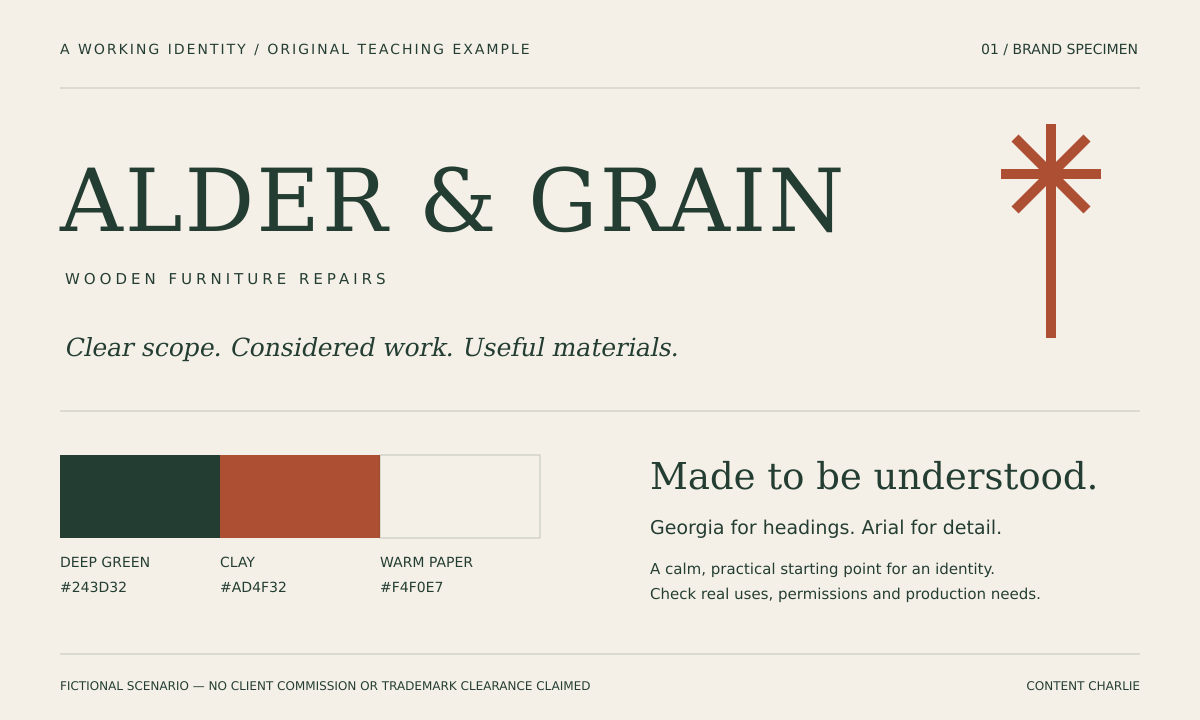
Open the SVG specimen to inspect the original graphic. It is a typographic teaching specimen using system-font fallbacks. Letter shapes may vary when those fonts are unavailable; it is not a printer-approved outlined master.
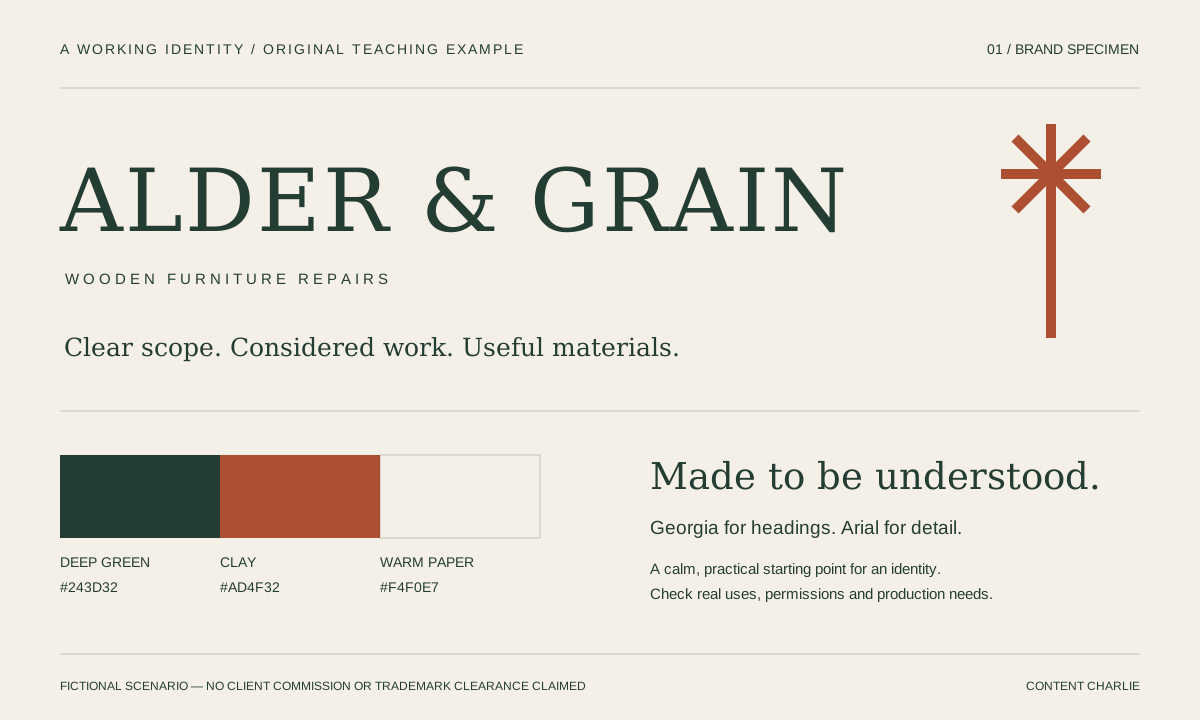
The screen palette is deep green #243D32, warm paper #F4F0E7 and clay #AD4F32. The text version here keeps the colour information available independently of the image.
What is in the teaching handover
| Item | Where to find it | Purpose |
|---|---|---|
| Original identity specimen | SVG specimen | Inspect the wordmark, light/dark presentation and palette. |
| Raster reference | PNG specimen | View a fixed-size rendering of the same teaching material. |
| Completed logo brief | Logo-design brief | See the audience, use cases, constraints and review criteria. |
| Usage guidance | Mini style guide | Apply the chosen colours, type roles, spacing and writing decisions. |
| Completed inventory | Example asset CSV | See how purpose, source status, responsibility and next actions are recorded. |
| Editable blank record | Blank asset CSV | Make an inventory for your own actual handover. |
The readable HTML guidance is part of the pack. The example inventory separates supplied teaching material from the additional production decisions a real brand project would require. A filename alone cannot establish editing capability or permission.
Using the identity in three contexts
Website header
Use the dark wordmark on a light surface. Keep the name readable at the actual mobile size and give a linked logo a meaningful accessible name. The W3C image guidance explains that the text alternative should reflect an image's purpose or function.
In this example, the descriptor is optional. Removing it at small sizes is preferable to making the whole name too small. Navigation labels and service instructions remain ordinary text, not part of the logo artwork.
Quotation document
Use the business name at the top, then prioritise the information the recipient needs: the item being assessed, proposed work, price, approval and collection arrangements. The identity should help someone recognise the document without crowding those details.
Check a monochrome office print at the intended size. A digital preview with vivid colour is a different context from a printed quotation kept with a piece of furniture.
Care card
Keep the identity secondary to the actual instructions. Any care advice would need to match the particular completed repair and materials. The example does not invent universal treatment instructions for furniture. Give the designer the final card size and the production supplier's requirements before making a print export.
A completed handover review
| Check | Result for this teaching pack |
|---|---|
| The name and scope are consistent | The same fictional name and repair process are used throughout the brief and examples. |
| The specimen can be inspected | A real local SVG file is supplied, with its role explained. |
| Colour roles are recorded in text | The three screen colours and their intended uses are listed. |
| Reading and display type have different roles | The mini-guide names the system-font approach and its limitations. |
| The inventory identifies the supplied material | The CSV records the specimen and supporting guidance. |
| Production assumptions are visible | Font redistribution, commercial-name clearance and printer specifications are separate checks before real-world use. |
This review establishes the contents of a teaching example. It is not a legal rights opinion, a print proof or an accessibility certification.
Apply the method to your own delivery
Open the blank checklist, list the files you actually received and give each one a purpose. Mark a source file as editable only after confirming it can be edited as intended. Record missing variants and unanswered permission questions with a specific next action.
If you are unsure which formats to request, use the logo-file guide before accepting the handover. The useful outcome is a pack someone else can understand and maintain.
The source notes
Sources and further reading
- W3C: choosing text alternatives for images Checked 4 November 2026
- W3C: Scalable Vector Graphics specification Checked 4 November 2026